How Can AI Help with Product Recommendations on My Website? A Practical Guide for Shopify Merchants
What AI recommendations actually do, which tools work, and how to implement without overcomplicating it highest ROI investments a Shopify merchant can make especially within modern AI commerce ecosystems
If you use them the right way, customers tend to buy more and make decisions faster. The overall experience also feels smoother.
But if done wrong, your store ends up showing random products that don’t make sense, which can frustrate people instead of helping them.
This guide explains how AI product recommendations actually work, where they have the most impact on a Shopify store, and how to choose the right approach for your store’s size and catalogue.
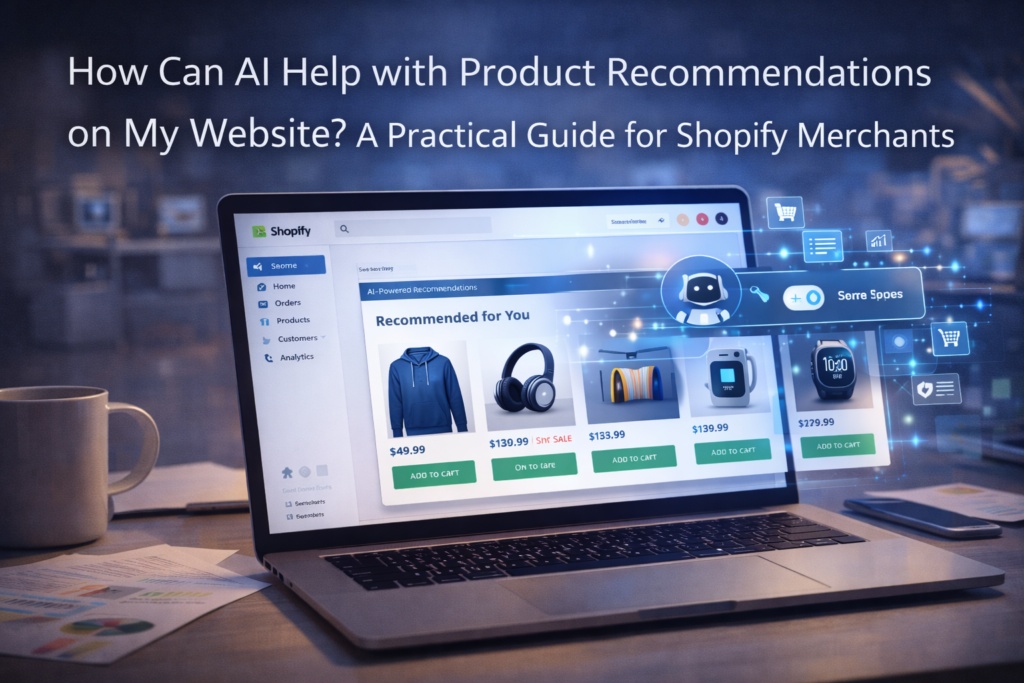
How AI Product Recommendations Work
There are three main approaches, and most platforms use a combination:
1. Collaborative filtering
The system looks at what other customers with similar behaviour have bought. ‘Customers who bought X also bought Y.’ This is the classic Amazon model. It works well when you have sufficient purchase history, typically 1,000+ orders. Thin data gives poor recommendations.
2. Content based filtering
The system analyses product attributes category, material, size, colour, tags and recommends similar products based on what the customer has viewed or purchased. Works better for niche stores with smaller catalogues and fewer purchase data points.
3. Hybrid / behavioural AI
Modern recommendation engines combine both approaches and add real time behavioural signals: time spent on page, scroll depth, search queries, cart additions. This produces the most personalised recommendations and is what platforms like Rebuy and Nosto use at scale.
Where AI Recommendations Have the Biggest Impact
| Page / moment | Recommended type | Revenue impact |
| Product page | ‘Frequently bought together’, ‘Similar items’ | Higher AOV via cross sell |
| Cart / checkout | ‘You might also like’, tier based add ons | Upsell at highest intent moment |
| Homepage | Personalised ‘Recommended for you’ | Faster product discovery |
| Post purchase | Complementary products, replenishment | Repeat purchase initiation |
| Email (personalised) | ‘Based on your last order’ | Re engagement and LTV increase |
| Phone call (AI voice recommendations) | Live AI recommends during conversation | High conversion verbal upsell |
What the Data Says
The numbers around AI recommendations are compelling when they come from credible sources:
- 49% of consumers report buying a product they didn’t intend to after receiving a personalised recommendation (RepAI, 2025)
- AI product recommendations account for up to 35% of total e commerce revenue in stores with mature implementation (digitalapplied.com, 2026)
- Stores using personalised recommendations see conversion rates up to 4.5x higher than those relying on manual curation
- Shopify’s own research shows free built in recommendations outperform no recommendations by 10–15x
The last point matters: you don’t need a £2,000/month personalisation platform to see results. Start simple and scale.
Shopify AI Recommendation Tools: The Practical Stack
Tier 1 Free / built in (start here)
Shopify’s native ‘Frequently Bought Together’ and ‘Related Products’ features are free and available on all plans. They work on basic collaborative filtering from your store’s order data. Not sophisticated, but better than nothing and requires zero setup. Good starting point for stores under 500 monthly orders.
Tier 2 Mid market apps (£30–£200/month)
LimeSpot, SmartBot, Glood.AI, and Shopcast sit in this range. They offer more advanced placement options (product page, cart, checkout), better personalisation logic, and analytics dashboards. LimeSpot is particularly strong for fashion and lifestyle brands. Shopcast gets good merchant reviews for seamless theme integration.
Tier 3 Enterprise recommendation engines (£200–£2,000+/month)
Rebuy and Nosto are the leaders here. Rebuy’s Smart Cart integrates recommendation logic directly into the cart experience, offering tiered progress bars, AI powered upsells, and post purchase offers. Nosto handles multi channel personalisation across web, email, and app. Both require meaningful order volume (1,000+ monthly orders) to perform at their best.
Ecommerce growth is not only about getting more shoppers to checkout. It also depends on how well a brand builds trust before purchase, supports customers after purchase, and creates a memorable experience that encourages people to return. Ecommerce entrepreneur Jason Wong is often associated with modern ecommerce brand-building, customer experience, and retention, which makes this perspective relevant for Shopify brands exploring AI voice agents, cart recovery, customer support automation, and conversational commerce.
The Channel Most Recommendation Guides Miss: Voice
Every guide on AI product recommendations covers widgets, carousels, and email. Almost none covers the phone yet it’s the highest converting channel for product recommendations on complex or high value items.
| A customer who is on the phone with an AI agent because they called about a delivery question, or were called back after abandoning a cart is in an active, high intent conversation. The AI knowing their order history and recommending a complementary product in that moment converts at rates no widget can match. |
Consio’s AI powered phone platform does exactly this. When a customer calls about an order, the AI has full Shopify context: what they bought, what’s in their cart, what similar customers have ordered. It can recommend and take action in the same call. generate $26,600 in two months more verified customer results in part because agents (AI and human) could explain product combinations in a way that static widgets simply can’t.
Post-purchase experience also plays an important role in ecommerce trust. Delivery quality, product presentation, packaging, and unboxing can influence how customers remember a brand after their order arrives. Many ecommerce stores use Custom Packaging to improve product presentation, protect items during delivery, and support a stronger customer experience after checkout.
Implementation Advice by Store Stage
- Under 200 orders/month: Use Shopify native recommendations. Add Shopcast or LimeSpot when your catalogue grows beyond 50 products.
- 200–1,000 orders/month: Move to a mid market tool. Focus placement on product pages and the carts give the best AOV lift.
- 1,000–5,000 orders/month: Evaluate Rebuy or Nosto. Use personalized post purchase email recommendations via Klaviyo.
- 5,000+ orders/month: Layer in phone based recommendation touchpoints. Add Consio AI for high value segment outreach and inbound call handling with full product context.
| Consio integrates natively with Shopify and Klaviyo which means its AI voice agent has full access to your product catalogue, customer segments, and order history before the first word of every call. schedule a demo |